Car seat guide · Decision framework

How to Choose a Car Seat: A Practical Buying Guide for Every Stage

A car seat is the most safety-critical purchase you will make for your child. Getting the type right first — and quality criteria established before brand comparison — is what gives that seat the best chance of doing its job when it matters most.

🚗 Type decision first 🏅 Quality before brand ⏱ 6 min

By Derrick Carvey, Founder, Carvey Innovations Limited · Originally published: April 1, 2026 · Updated: July 27, 2026

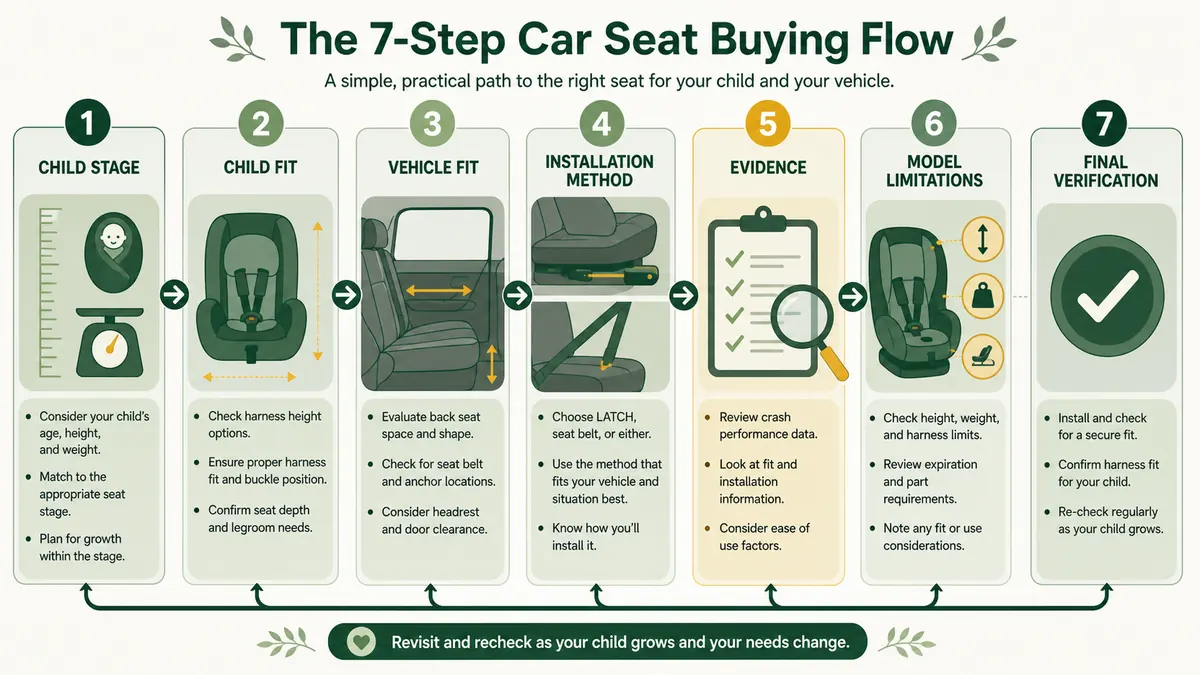
Seven-step car-seat buying framework from child stage through final verification
Category is only the start: child fit, vehicle fit, installation, evidence, and model limitations complete the decision.

What should you look for when choosing a car seat?

Choose a car seat by checking five kinds of fit: the child, the vehicle, the correct safety stage, the family’s daily routine and the evidence for the exact model. Confirm the child’s current height, weight and harness fit; read both manuals; and use an installation method permitted by the seat and vehicle. Make sure every caregiver can install, adjust and use it consistently. Before buying, verify the exact model, labels, manufacture date, useful-life guidance, instructions and recall status. Price, brand and extra features come after these checks—a highly rated or expensive seat can still be the wrong fit.

Buying decision summary

Child: current fit and next stage. Vehicle: seating position, space and installation. Safety stage: rear-facing, harness, booster or belt. Daily life: a routine every caregiver can repeat. Evidence: exact-model labels, manuals, seller and recalls.

The VerifyBabyGuide Five-Fit Framework

The VerifyBabyGuide Five-Fit Framework is our Verification-First Decision Model for evaluating baby gear. Rather than beginning with brands, popularity or price, it guides parents through five evidence-based areas that determine whether a product is genuinely appropriate for their child, vehicle, home and everyday routine. The same methodology is adapted throughout VerifyBabyGuide so that different buying guides follow a consistent decision process before product comparison begins.

Verification-First Decision Model

VerifyBabyGuide uses the Verification-First Decision Model across its buying guides. The Five-Fit Framework is the practical decision tool used within that model to evaluate products consistently before comparing brands.

The right car seat must fit five things: the child, the vehicle, the safety stage, the family’s daily routine, and the evidence that can be verified for the exact model. Use all five checks before comparing brands.

1. Child Fit

Verify current height, weight and developmental stage against the manufacturer’s minimum and maximum limits. Check harness position and fit, newborn suitability where applicable, the required recline, and whether any supplied insert is approved for that exact model. Age is useful orientation, but it must not override stated limits or actual fit.

2. Vehicle Fit

Check the intended rear seating position, seat shape and contour, permitted lower-anchor or ISOFIX use, seat-belt feasibility, tether availability where required, front-passenger clearance, recline space, buckle position and belt-path access. The installation must be permitted by both manuals. A highly rated seat can still be unsuitable for a particular vehicle.

3. Safety-Stage Fit

The normal progression is rear-facing, forward-facing with a harness, belt-positioning booster, then the adult vehicle belt. Transitions depend on manufacturer limits and correct fit—not birthdays alone. Do not move a child to the next stage merely because they have reached a particular age.

4. Daily-Life Fit

Consider multiple caregivers and vehicles, portability, stroller compatibility, air travel, seat weight, repeated installation, cleaning and harness adjustment. Ask whether grandparents and other caregivers can use the seat consistently. Usability matters because the seat must be used correctly on every trip.

5. Verification Fit

Verify the exact model name and number, manufacture date, expiration or useful-life guidance, recall status, required labels, complete instructions, included original parts, seller authenticity and—if used—known crash history. Review exact-model testing or ratings where available, including their date and limitations.

Five Questions to Answer Before You Compare Brands

  1. What seat mode does my child need now?
  2. Will this exact seat fit my intended vehicle position?
  3. Can every caregiver install and adjust it correctly?
  4. Does it support the next realistic stage without compromising current fit?
  5. Can I verify the exact model, seller, labels, recall status and instructions?

Whether you are choosing a car seat today or comparing strollers, baby monitors or other nursery products later, the same VerifyBabyGuide Five-Fit Framework can help you organize the decision before comparing brands.

Parents shopping for a car seat usually start with brand and price. This guide starts earlier — with seat type, then quality criteria, then installation confidence. Getting that sequence right is what gives a car seat its best chance of working when it matters most.

The numbers that reframe this decision

Before anything else, it helps to understand what a correctly chosen and correctly used car seat actually means for a child's safety. The data from the National Highway Traffic Safety Administration is clear and worth knowing.

71%
Reduction in fatal injury risk for infants in rear-facing car seats compared to no restraint.
Source: NHTSA, 2023 Children Traffic Safety Data
54%
Reduction in fatal injury risk for toddlers ages 1 to 4 in correctly used car seats.
Source: NHTSA, 2023 Children Traffic Safety Data
46%
Of car and booster seats are misused — meaning a certified seat is present but not providing its full protection.
Source: NHTSA National Child Restraint Use Special Study

That last number is the one that deserves the most attention. The protection a car seat offers is only realised when the right type is chosen for the child's stage, installed correctly, and used correctly every single time. This is not a criticism of parents — it is a reflection of how much complexity is packed into a purchase that most people approach by comparing brands and prices.

The framework here starts earlier than brand comparison. It starts with type, then quality criteria, then installation, and finally verification. Brand comes last — not because it doesn't matter, but because without the criteria established first, brand comparison has no anchor.

The type decision — the one that must come first

Car seats fall into five common categories, each intended for particular modes and manufacturer-defined fit limits. Age helps orient a buyer, but height, weight, developmental readiness, actual fit and the manufacturer’s limits determine when to change modes. For the two most common newborn options, see the infant versus convertible car seat comparison.

Infant-only seats

Designed exclusively for rear-facing use within the exact model's stated child-fit requirements. The smallest and most portable option — many include a detachable carrier that clicks into a base. The trade-off is a shorter usable window. A child will generally outgrow an infant seat before a convertible.

Right for: Families who want maximum portability in the newborn stage and are comfortable purchasing a convertible seat when the child outgrows it.

Convertible seats

Designed to be used rear-facing first, then converted to forward-facing when the child and exact model meet the manufacturer requirements. Convertible seats commonly provide a longer rear-facing use window than infant-only seats, but the limits vary by model. NHTSA recommends keeping children rear-facing as long as their specific seat permits.

Right for: Families who want to extend rear-facing use and reduce the number of seat transitions. The most common choice for families who want value across a longer window.

All-in-one seats

Designed to provide rear-facing, forward-facing harness and belt-positioning booster modes in one seat, subject to the exact model's requirements in each mode. These seats may provide a longer overall use window, but fit, installation and usability must be reassessed at every transition.

Right for: Families who want a single seat across the full child passenger journey and are comfortable with a heavier, less portable option.

Combination seats

Forward-facing harness seats that later become belt-positioning boosters. They do not rear-face and are for children who have outgrown the rear-facing limits of their prior seat and meet the model requirements.

Booster seats

Position the vehicle lap-and-shoulder belt across the child. Use only after the forward-facing harness is outgrown and until the vehicle belt fits properly without a booster.

Stage guidance without age-only shortcuts

Newborn or infant: rear-facing in an infant-only, convertible or all-in-one seat that provides correct harness and recline fit. Toddler: remain rear-facing until the model’s limit is reached. Preschool or forward-facing stage: use a harness and tether after rear-facing is outgrown. Booster stage: move only after the harness limit is reached and use the booster until the vehicle belt fits correctly.

The key principle

No seat type is objectively best. The right type is determined by your child's current stage, how long you want the seat to last, and whether portability or longevity matters more for your daily routine. Establish this before any brand enters the conversation.

Quality criteria — what to establish before comparing brands

Once the type is determined, quality criteria give you an objective standard against which to evaluate any seat — regardless of brand, price, or marketing language. Without these criteria, brand comparison becomes subjective and susceptible to the very features that matter least to actual safety.

FMVSS 213 compliance — the non-negotiable baseline

Every car seat sold legally in the United States must meet Federal Motor Vehicle Safety Standard 213. This is the federal crash performance, flammability, and labelling requirement. Look for the compliance statement on the seat's physical label — not just in the product listing. The label on the seat itself is the confirmation. The listing is the claim.

Baby Safety Alliance Verification Program — a voluntary layer

JPMA rebranded as the Baby Safety Alliance, and the legacy JPMA Certification Program transitioned to the current Verification Program. It is separate from FMVSS 213, is not federal approval, and should be checked for the exact product and scope. Brand or category participation alone does not establish exact-model verification.

NHTSA Ease-of-Use ratings — the installation confidence layer

NHTSA's Ease-of-Use ratings help parents compare how clearly seats communicate installation and use steps. Use the ratings alongside the exact manuals, child fit, vehicle fit, and hands-on installation rather than treating a higher score as proof that misuse is less likely in every household.

Active recall status — the verification step

Car-seat recalls identify defects or noncompliance requiring an official remedy. No active recall does not prove that a seat fits your child or vehicle, but recall status is a necessary exact-model check. Search the NHTSA database before buying, register the seat, and check again when it arrives.

The quality-first principle

At Verify Baby Guide, quality criteria are always established before product selection. We find which seats meet the criteria first — then evaluate price within that qualified group. A seat that fails the criteria is not a budget option. It is not an option.

A Certified Car Seat Can Still Be the Wrong Car Seat

Certification confirms that a product met the applicable regulatory requirements. It does not prove that the seat fits a specific child, installs correctly in a specific vehicle, works for a family’s routine, or performs better than competing models.

Under the VerifyBabyGuide Verification-First Decision Model, certification is one important layer of evidence—not the entire buying decision. The Five-Fit Framework helps place certification alongside child fit, vehicle compatibility, caregiver usability and exact-model verification.

Certification can help confirmCertification does not automatically confirm
Applicable regulatory complianceCorrect fit in your vehicle
Required crash-test baselineCorrect fit for your child
Required labels and instructionsEase of installation
Legal eligibility for saleCaregiver usability
Minimum regulatory performanceComparative performance against rivals
Product identity when verifiedSuitability for your daily routine

Why the highest score is not automatically the best choice

A score is a summary. The evidence underneath it is the buying decision. Consumer Reports scored the Graco Extend2Fit 73 and recommended it, with strong rear-facing fit and documented usability trade-offs. Britax One4Life ClickTight scored 71 with excellent fit-to-vehicle results, while CR separately documented harness slippage or loosening in specified forward-facing crash-test configurations. Safety 1st Guide 65 scored 67 and had documented rear-facing installation difficulties.

VerifyBabyGuide does not treat those numbers as a universal ranking. Compare the exact-model findings, evidence age, child fit, vehicle fit, installation method, and material limitations before deciding.

How Do You Know Whether a Car Seat Fits Your Vehicle?

Read both the vehicle owner’s manual and the exact car-seat manual before deciding. Confirm approved rear seating positions; lower-anchor or ISOFIX availability and limits; the permitted seat-belt route and locking method; top-tether requirements; vehicle head-restraint instructions; recline requirements; front-seat clearance; and any centre-seat or under-floor-storage restrictions.

For three-across arrangements, confirm that each restraint can be installed and used independently without blocking a buckle or forcing a neighboring seat out of position. Check whether the vehicle buckle interferes with the belt path and whether adjustments remain reachable.

In the United States, a car seat may be secured with the vehicle belt or the LATCH lower anchors when that method is permitted. Internationally, ISOFIX is related terminology. Neither ISOFIX/LATCH nor a seat-belt installation is automatically safer in every situation: use the method allowed by both manufacturers, within the stated limits, that can be installed correctly.

Test the exact seat in the intended vehicle before the return period ends whenever possible. Confirm passenger space and practical access for every caregiver. For belt paths, recline, tether use, movement checks and professional verification, follow the detailed guide on how to install a car seat correctly.

Purchase test

A strong rating cannot guarantee fit in your child, vehicle or routine. Return a seat that cannot be installed and used correctly under the manufacturer instructions.

Installation and Caregiver Fit

Installation feasibility and daily-life usability are buying criteria. Ask each regular caregiver to locate the correct belt path or lower-anchor route, tighten and release the harness, position the chest clip where the manual directs, read the indicators, and repeat the routine without improvising.

Consider repeated transfers between vehicles, seat weight, cleaning, air-travel plans and stroller use only after the child and vehicle checks pass. A convenience feature has value when it helps caregivers use the seat correctly and consistently; it does not substitute for correct fit.

Choosing the right seat is the first step. Verifying what arrives is the last.

A certification mark on a product listing represents a claim — that a specific batch, from a specific facility, at a specific point in time, met the required standard. It does not automatically guarantee that the unit delivered to your door was part of that certified batch.

Counterfeit and grey-market car seats are a documented problem in online marketplace environments. The gap between a certification claim and the unit in your hands is real — and it is closeable. The certification databases are public, free, and designed to be used.

Buy informed. Verify always.

Before buying or using a seat, check the NHTSA recall database, current Baby Safety Alliance program scope where relevant, exact model identity, and the FMVSS 213 compliance label on the seat itself.

Why certification verification matters — and how to do it →

Can You Buy a Second-Hand Car Seat?

Prefer a new seat where possible and avoid a used seat with an unknown history. Consider one only when you can verify the exact model and manufacture date, full crash history, current recall status, expiration or useful-life guidance, required labels, instructions and all original parts.

Reject a seat with cracks, stress marks, missing identity labels or unauthorized accessories. A seat does not automatically need replacement after every minor crash under current U.S. guidance; follow the exact manufacturer’s crash-replacement instructions and applicable official guidance. If the history cannot be confirmed, do not rely on the seat.

Verification fit

Known provenance is the dividing line. A low price cannot compensate for missing identity, crash-history or useful-life information.

What Do Group 1, Group 2 and Group 3 Mean?

These are legacy terms from the older UN R44 weight-based approval system, not U.S. FMVSS 213 categories:

  • Group 1: traditionally 9–18 kg
  • Group 2: traditionally 15–25 kg
  • Group 3: traditionally 22–36 kg

Modern UN R129 approvals, often discussed with i-Size, primarily classify seats by the child’s stature and use updated approval requirements. Treat the older groups as label-decoding information, not the preferred modern buying framework.

Regional note: This guide primarily uses United States guidance, FMVSS 213 and LATCH terminology. Car-seat standards and legal requirements vary by country. Confirm the approval label and rules applicable where the seat will be used.

Car-Seat Buying Questions

What should I look for when buying a baby car seat?

Use the Five-Fit Framework: confirm child fit, vehicle fit, the correct safety stage, daily-life usability and verifiable evidence for the exact model. Check height and weight limits, both manuals, installation methods, labels, manufacture date, useful-life guidance and recalls before comparing price or brand.

What type of car seat should a child use by age?

Age provides orientation, not the transition rule. A child normally progresses from rear-facing to a forward-facing harness, then a belt-positioning booster and finally the adult vehicle belt. Make each change only when the child meets the applicable height, weight, fit and manufacturer requirements.

What do Group 1, Group 2 and Group 3 mean?

These are legacy weight groups under the older UN R44 system: Group 1 was traditionally 9–18 kg, Group 2 was 15–25 kg and Group 3 was 22–36 kg. Modern UN R129 approvals primarily classify seats by the child’s stature and updated approval requirements. Check the approval label and rules where the seat will be used.

Should a baby car seat go behind the driver or passenger?

Use an appropriate rear seating position where the exact seat can be installed correctly under both manuals. The centre may provide more distance from a side impact, but it is not automatically best if the installation is prohibited, unstable or impractical. Neither the driver nor passenger side is universally safer. Kerbside loading may be more convenient in some places, depending on local traffic direction and parking.

Is ISOFIX safer than seat-belt installation?

Neither method is automatically safer in every situation. Use the method permitted by the car-seat and vehicle manuals, within all stated limits, that can be installed correctly and repeated reliably by the caregiver. In the United States, the comparable lower-anchor system is called LATCH.

Can you buy a second-hand car seat?

Prefer a new seat where possible and avoid a used seat with an unknown history. Consider one only when you can verify its identity, full crash history, recalls, useful-life guidance, labels, instructions and original parts, and it has no cracks, stress marks or unauthorized accessories. Follow the exact manufacturer’s crash-replacement guidance and current official guidance.

When should a child change car seats?

Change mode or seat when the child reaches an applicable manufacturer-stated height, weight or fit limit, or when the seat no longer provides correct fit. Do not transition merely because of a birthday. Recheck the manual at every stage change.

What type of car seat does a newborn need?

A newborn may use an infant-only seat or a rear-facing convertible or all-in-one seat only when the exact model permits use from birth, the child meets its minimum fit requirements, the harness and recline fit correctly, approved inserts are used as directed, and the seat installs correctly in the vehicle.

What is the safest type of car seat?

No category is universally safest for every child and vehicle. Use an appropriate seat for the child’s current stage that fits the child and vehicle, can be installed and used correctly, and has verifiable exact-model labels, instructions and recall status.

How long can a child use a convertible car seat?

Use depends on the exact model’s permitted modes and the child’s fit within its stated height, weight and other requirements. Follow the label and manual rather than a typical age or general numerical range.
Move from category to exact-model evidence

Use NHTSA car-seat selection and installation guidance, the exact manufacturer manual, vehicle manual and current exact-model records. For a used seat, review NHTSA’s second-hand seat checklist and post-crash replacement guidance. The UNECE child-restraint brochure explains the older UN R44 groups and UN R129 framework.

Next, compare infant and convertible seats, review the focused installation guide, then use the car-seat checklist.

The Verification-First Decision Model is used throughout VerifyBabyGuide. While the Five-Fit Framework adapts to different products, the principle remains the same: establish objective decision criteria first, then compare brands within those criteria.