Quick answer
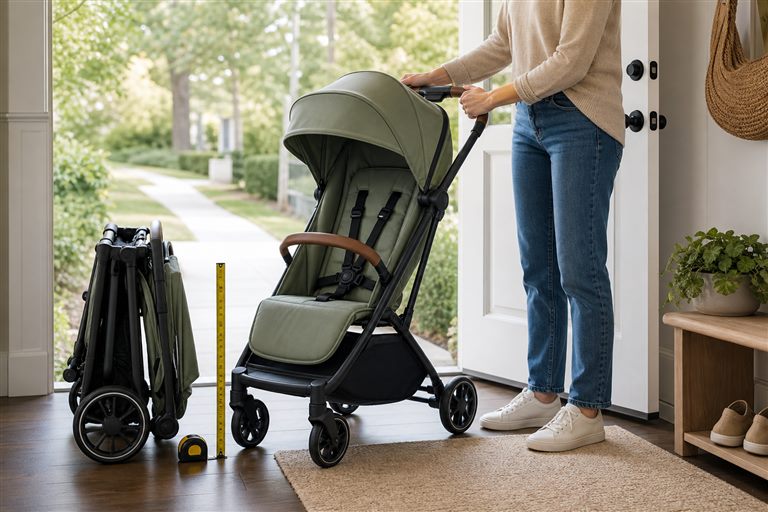
Choose a baby stroller by matching a manufacturer-approved configuration to your baby's stage, then testing it against your actual routine. Look for a secure restraint, reliable brakes, stable handling, an approved newborn setup if needed, manageable lifting weight, usable folded dimensions, suitable wheels and suspension, accessible storage, and a fold you can operate safely. Push and turn it with realistic weight, lift it into your vehicle, and measure the storage space rather than relying on listing photos. Confirm car-seat or bassinet compatibility through the manufacturer, not only a retailer. Before buying, read the instructions, identify the exact model, review support and return terms, and search CPSC recalls and warnings. Use the Baby Stroller Safety Checklist for model-level verification.
The Verification-First Decision Model
Most stroller buying advice begins with brands, popularity, “best stroller” lists or influencer recommendations. Those sources may surface options, but they do not establish whether a particular stroller fits the child, the family’s routine, the intended environment or the available evidence.
VerifyBabyGuide begins with objective decision criteria before product comparison. The Verification-First Decision Model first defines what must fit, then checks the documentation and evidence attached to the exact product. Brands and prices are compared only after those requirements are clear.
The best stroller is not the one with the most features. It is the stroller that best fits your child, your environment, your routine and the available verification evidence.
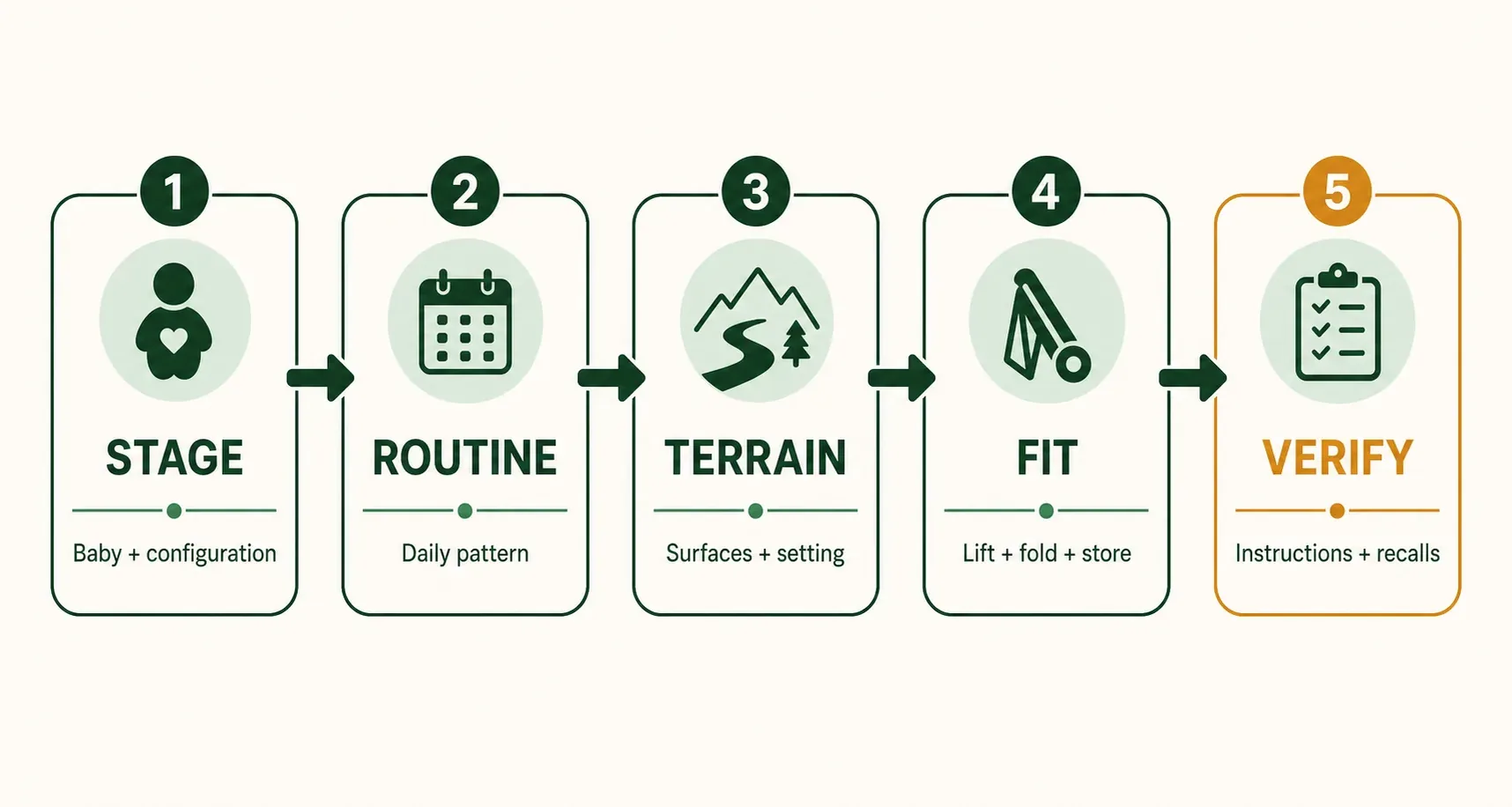
The VerifyBabyGuide Five-Fit Framework for Strollers
Within the Verification-First Decision Model, the Five-Fit Framework turns objective criteria into five practical checks. Child fit comes first; verification evidence supports the final product decision.
Confirm that the exact configuration is approved for the child now.
- Approved newborn configuration
- Age and weight limits
- Growth stage
- Harness suitability and adjustment
Child Fit comes first because features and convenience cannot make an unapproved configuration appropriate.
Match the stroller to routine use rather than an occasional ideal scenario.
- Travel frequency
- Shopping and errands
- Stairs and public transportation
- Neighborhood walks
- A realistic plan for an expanding family
Evaluate where the stroller will move and where it will be kept.
- Routine terrain
- Wheel size and material
- Suspension and clearance
- Weather exposure
- Home and vehicle storage conditions
Apply the VerifyBabyGuide Lift–Fold–Fit Test to the exact stroller.
- Lift: weight, grip points and caregiver strength
- Fold: repeatable operation under real conditions
- Fit: folded dimensions, vehicle opening and storage space
- Maneuverability in the spaces used most
Match each claim to the exact model and current evidence.
- ASTM F833 and 16 CFR Part 1227
- Children’s Product Certificate
- Baby Safety Alliance verification scope
- Recall history and exact-model identity
- Approved accessories and instruction manual
- Manufacturer support
Verification Fit confirms that the stroller being purchased—not simply the brand—is supported by the available evidence.
Verification Fit is the final step because it confirms the exact stroller being purchased—not simply the manufacturer or retailer listing—is supported by current documentation and available evidence.
This is a practical editorial buying framework. It has no regulatory endorsement or clinical validation.
What should you look for in a baby stroller?
Child Fit: an approved configuration, limits and harness for the child. Lifestyle Fit: a match for the routine used most. Environment Fit: wheels, suspension, terrain, weather and storage conditions. Practical Fit: lifting weight, fold, dimensions, maneuverability and vehicle space. Verification Fit: exact-model requirements, instructions, certificates, accessory approvals, support and recalls.
Stroller types at a glance
| Type | Best suited for | Main advantage | Main trade-off | Important verification question |
|---|---|---|---|---|
| Full-size / everyday | Frequent walks and broad daily use | Comfort, storage and features | Weight and folded bulk | Can the caregiver lift and store it? |
| Compact | Small vehicles, apartments and transit | Smaller folded footprint | May reduce basket space or ride comfort | Does it fit the exact constrained space? |
| Lightweight / travel | Frequent carrying and trips | Lower lifting burden | Smaller wheels or fewer adjustments | Is the intended age and terrain approved? |
| Travel system | Families using an infant car seat frequently | Approved car-seat-to-stroller connection | Bulk and short-lived infant-seat phase | Is the exact seat or adapter approved? |
| Jogging / all-terrain | Rough surfaces or actual running, when approved | Larger wheels and surface capability | Length, weight and turning space | Does the manufacturer approve jogging and at what stage? |
| Single-to-double | Families likely to transport two children | Future configuration options | Cost, weight and maneuverability | Which seat combinations and limits are approved? |
Start with your life, not the stroller
The strongest match is not the stroller with the longest feature list. It is the stroller that safely fits the baby's stage, the family's daily environment, transportation routine, storage constraints and actual pattern of use.
Write down where it will live, the number of stairs between storage and the street, whether it must enter a lift, bus or train, and the exact vehicle trunk or boot opening—not just its volume. Name the primary caregiver and how often that person will lift it. Add travel frequency, rain or heat exposure, pavement quality, narrow aisles, parks and plans for another child. This use case is your filter; marketing features come later.
What type of stroller do you actually need?
Full-size / everyday
Best suited for: regular neighborhood walks and families wanting storage and adjustability.
Advantages: broader feature set and often a more substantial seat and basket.
Trade-offs: lifting weight and folded bulk.
Do not choose it if you cannot carry or store the exact model.
Compact
Best suited for: apartments, small vehicles and crowded transport.
Advantages: space-efficient fold and easier maneuvering in tight settings.
Trade-offs: basket access, wheel size or fewer configurations.
Do not choose it if its wheels and limits do not match routine surfaces or stage.
Lightweight / travel
Best suited for: frequent lifting and travel.
Advantages: lower carry burden.
Trade-offs: smaller wheels, less storage and possible limits on newborn use.
Do not choose it if low weight requires sacrificing capabilities you use daily.
Travel system
Best suited for: frequent transitions with a compatible infant car seat.
Advantages: an approved connection without moving the baby between seats.
Trade-offs: bulk and a configuration the child will outgrow.
Do not choose it if the bundle dictates a poor stroller or car-seat fit.
Jogging / all-terrain
Best suited for: rough surfaces or running when the exact model and child stage are approved.
Advantages: larger wheels and terrain capability.
Trade-offs: weight, length and turning radius.
Do not choose it if a three-wheel appearance is your only evidence that it is jogging-approved.
Convertible single-to-double
Best suited for: a realistic plan to transport two children during the stroller's useful life.
Advantages: future seating options.
Trade-offs: price, weight, storage footprint and configuration limits.
Do not choose it if future capacity is speculative and burdens every use today.
Can a newborn use the stroller?
Newborn suitability depends on manufacturer-approved age and weight limits and the exact configuration. Depending on the product, that may be a bassinet approved for the stroller, a compatible infant car seat attached according to the compatibility instructions, or a stroller seat the manufacturer explicitly approves for use from birth.
A deep or “near-flat” recline is not proof by itself. Find the manual for the exact model and check the seat, accessory and adapter directions. If the documentation does not approve your intended newborn configuration, do not infer approval from a retailer description.
How much should stroller weight and folded size matter?
Weight and fold design become major usability factors when someone regularly carries the stroller upstairs, boards transit, loads a vehicle, travels or stores it in a narrow space. Published numbers are useful, but they do not show grip points, awkward shape, wheel position or whether the fold is reliable in your routine.
The VerifyBabyGuide Lift–Fold–Fit Test
Lift: Can the primary caregiver comfortably lift and carry the stroller under realistic conditions?
Fold: Can it be folded and unfolded reliably where it will actually be used?
Fit: Does the folded stroller fit the real vehicle opening, entryway, storage area, elevator or other constrained space?
This is a practical decision framework, not a regulatory safety test.
How should terrain affect your stroller choice?
Smooth pavement and shopping centers may favor compact dimensions and tight maneuvering. Broken sidewalks, gravel, parks and rural surfaces may increase the value of larger wheels, suitable wheel material, suspension and clearance—but also add weight and turning space. Consider puncture risk and maintenance where air-filled tires are used.
Compare the stroller's width and turning radius with narrow urban spaces. For actual running, use only a stroller the manufacturer explicitly approves for jogging, at the child stage and with the setup it specifies. A three-wheel frame alone is not evidence of approval.
Which stroller safety features should you verify?
Verify the restraint system, parking brakes, frame and folding locks, stability and loading instructions, pinch or entrapment warnings, manufacturer identification and recall history. In the United States, the mandatory carriage and stroller standard is 16 CFR Part 1227, which incorporates ASTM F833 as accepted and modified by the CPSC.
Use the Baby Stroller Safety Checklist to apply the Verification-First Decision Model to a specific stroller. Then use the broader Verify Your Product process to compare the delivered model, labels and documentation with the seller’s claims.
Independent Verification Evidence
No single standard, certificate, laboratory name or rating answers the entire buying question. Each evidence source has a defined purpose. Match it to the exact stroller and use it alongside the five fit checks.
| Evidence source | Purpose |
|---|---|
| ASTM F833 | Provides the technical consumer-safety specification for carriages and strollers. In the United States, the CPSC-accepted version is incorporated into the mandatory federal rule; citing ASTM F833 alone does not establish exact-model identity, daily fit or current recall status. |
| 16 CFR Part 1227 | Establishes the mandatory U.S. federal safety standard for carriages and strollers and incorporates ASTM F833 with CPSC modifications. Compliance is a baseline requirement, not proof that the stroller fits a particular child or routine. |
| Children’s Product Certificate (CPC) | The responsible U.S. manufacturer or importer certifies that the identified children’s product complies with applicable CPSC-enforced rules, based on qualifying evidence such as third-party test results. Confirm that the certificate identifies the exact product; a CPC is not a comparative product rating. |
| Baby Safety Alliance Verification Program | Adds a voluntary verification layer for products within the program’s current scope. A manufacturer or category listing is a starting point—not automatic proof that every stroller from that brand is verified. |
| Intertek or Bureau Veritas | Laboratories may conduct testing when the specific lab, rule and accreditation scope are appropriate. A laboratory name in marketing copy does not by itself prove what was tested; review the exact-model report, date, rule and issuing laboratory details. |
| CPSC recalls | Identify announced recalls and remedies tied to products, models and date ranges. No recall found does not prove universal safety or suitability; search using the exact model and manufacture information. |
| GREENGUARD Gold, where applicable | Addresses chemical-emissions criteria for an exact certified product. It does not replace stroller structural-safety requirements, a CPC, fit checks or recall review. |
| Consumer Reports | May add independent comparative findings on safety assessments, ease of use, maneuverability, folding and carrying for tested models. A score is not regulatory approval and cannot guarantee fit in a particular household. |
| VerifyBabyGuide Five-Fit Framework | Organizes child, lifestyle, environment, practical and verification evidence into a repeatable buying decision. It is an editorial decision tool—not a certification, regulatory test or substitute for manufacturer instructions. |
Brand Listing vs Exact-Model Verification
A manufacturer appearing in the Baby Safety Alliance Verification Program directory does not automatically mean every stroller produced by that manufacturer is independently verified. Directory language may distinguish membership, product categories and verified products; buyers still need to match the evidence to the exact stroller.
For familiar names such as UPPAbaby, Baby Jogger or Graco, do not infer a model’s status from the brand name, a retailer badge or another product in the company’s range. Check the current program record and exact-product evidence, then confirm the model number and documentation on the stroller received. This distinction is between manufacturer participation and exact-product verification, not a judgment about any unreviewed model.
Common Verification Mistakes Parents Make
- Assuming every stroller from one brand has identical certifications or evidence.
- Treating retailer descriptions as a replacement for manufacturer instructions or a CPC.
- Assuming a travel-system label guarantees universal car-seat or adapter compatibility.
- Checking the brand but not the exact model and manufacture information in the CPSC recall database.
- Ignoring folded dimensions, lifting weight and the real vehicle or home storage opening.
- Confusing manufacturer participation in a voluntary program with exact-model verification.
Verification is specific: match the claim, certificate, report, accessory approval or recall search to the exact product being considered.
Should you choose a travel system?
A travel system can make short transitions convenient because an approved infant car seat connects to the stroller. Verify the exact seat, stroller and adapter combination rather than assuming products from the same brand are interchangeable. Account for the combined bulk, stroller performance without the car seat, and the limited period in which the infant-seat configuration fits the child. Convenience does not make a travel system the best fit for every newborn or family.
How much stroller storage do you actually need?
List what you routinely carry: diaper bag, groceries and caregiver essentials. Check basket capacity, opening size and access when the seat is reclined or a second seat is installed. Follow the manufacturer's basket weight limit. Do not hang unapproved bags or loads from the handle; added leverage can affect stability. Use designated storage.
Should you buy a stroller that converts to a double?
The premium may be justified when another child is likely within the product's useful life and the approved configurations match the expected age gap. Compare the weight, cost, turning space, storage footprint and access to both seats in the configurations you would use. Buying future capacity that never gets used is expensive overbuying; buying it when the timeline is realistic can avoid replacing the stroller.
Questions to ask before buying a stroller
- Can my baby use this exact stroller configuration at their current age and weight?
- Does the manufacturer approve every seat, bassinet, car seat and adapter I intend to use?
- Can the primary caregiver lift and carry it comfortably?
- Does the folded stroller pass the real vehicle and storage fit check?
- Can it be folded and unfolded under realistic conditions?
- Does the parking brake engage and hold as the instructions describe?
- Can every supplied restraint be adjusted correctly for the child?
- Do the wheels, suspension, dimensions and approved use match the terrain?
- What are the child, seat, basket and accessory weight limits?
- Are replacement parts and current instructions available?
- What does the warranty cover, exclude and require for a claim?
- Has this exact model been recalled?
- Can I verify the manufacturer, model number and manufacture date on the product?
Final decision table
| Situation | Category to investigate | Highest priority | Biggest trade-off | Verify before buying |
|---|---|---|---|---|
| Newborn + frequent car use | Travel system | Approved car-seat connection | Bulk and short use phase | Exact seat, adapter, limits |
| City apartment + stairs | Compact or lightweight | Carry weight | Wheel and basket capability | Lift and folded dimensions |
| Frequent air travel | Travel stroller | Fold and handling | Reduced everyday features | Airline stroller policies, folded dimensions and child-stage limits |
| Broken sidewalks / parks | All-terrain | Wheels and control | Weight and turning space | Approved surfaces and maintenance |
| Runner intending to jog | Jogging stroller | Explicit jogging approval | Size and weight | Child stage, instructions and wheel setup |
| Growing family | Single-to-double | Approved configurations | Cost and maneuverability | Seat limits and actual footprint |
| Limited vehicle storage | Compact | Folded fit | Storage or wheel size | Actual opening and orientation |
| Low lifting-weight priority | Lightweight | Real carry comfort | Terrain and features | Stage, stability and limits |
Frequently asked questions
How do I choose the right baby stroller?
Use the VerifyBabyGuide Five-Fit Framework to assess child, lifestyle, environment, practical and verification fit. Match an approved configuration to the child, test the stroller against the real routine, and verify exact-model instructions, evidence and recalls before comparing brands.
Which stroller type is best suited for everyday use?
There is no universal best fit. A full-size stroller may suit frequent neighborhood use, while stairs, transit or a small vehicle may make a compact or lightweight stroller the better match.
Can a newborn use a regular stroller?
Only when the manufacturer explicitly approves the exact stroller seat or an attached bassinet or infant car seat for the newborn's stage and configuration.
What is the difference between a travel system and a stroller?
A stroller is the wheeled product. A travel system is a stroller-and-infant-car-seat combination designed for approved compatibility, either through direct attachment or a manufacturer-approved adapter.
How heavy is too heavy for a stroller?
There is no universal cutoff. It is too heavy for your routine if the primary caregiver cannot safely and comfortably lift, carry, fold and store it under realistic conditions.
Do I need an all-terrain stroller?
Consider one if rough or mixed surfaces are routine. On smooth indoor floors and pavement, larger wheels and extra weight may add little value.
Is a five-point harness important on a stroller?
A properly used restraint system is safety-critical. Many strollers use a five-point restraint system with shoulder, waist and crotch restraints. Use every restraint supplied with the stroller and adjust it according to the manufacturer's instructions for the child and configuration.
Should I buy a stroller that converts to a double?
It may justify its cost and weight when another child is likely within its useful life. Otherwise, it can be unnecessary bulk and expense.
How do I check whether a stroller has been recalled?
Find the exact model number and manufacture information, then search the CPSC recall database and manufacturer safety notices.
What should I check before buying a used stroller?
Verify identity, recall status, instructions, labels, restraints, brakes, locks, wheels, approved parts and product history. Do not buy if identity, history or condition cannot be established.
Authoritative sources and further verification
For additional Verification-First Decision Model checklists and buying guides, browse the VerifyBabyGuide Library.
- CPSC: Carriages and Strollers Business Guidance
- eCFR: 16 CFR Part 1227
- CPSC: Children’s Product Certificate guidance
- CPSC recalls and product safety warnings
- Baby Safety Alliance Verification Program
- UL Solutions: GREENGUARD Certification Program
- Consumer Reports: How strollers are tested
- VerifyBabyGuide certification glossary
The VerifyBabyGuide Approach
VerifyBabyGuide helps parents move beyond “best stroller” lists by focusing on five areas before product comparison:
- Child Fit
- Lifestyle Fit
- Environment Fit
- Practical Fit
- Verification Fit
When those five areas align, families are far more likely to choose the stroller that truly fits their needs rather than simply following popularity.
Continue Your Stroller Decision
You have now used the VerifyBabyGuide Five-Fit Framework to define the child, lifestyle, environment, practical and verification criteria for this purchase.
Continue the Verification-First Decision Model by checking the exact safety evidence before adding a stroller to your overall baby plan.
Open Stroller Checklist →Next step: planning. Add the stroller category to your Smart Baby Shopping Planner to organize cost and baby-gear priorities while retaining the Five-Fit verification checks that still need attention.
Plan My Stroller Purchase →